
The Freelancer Late-Payment Playbook: Terms, Reminders, and What to Do When a Client Goes Quiet
A complete, simple playbook for getting paid on time as a freelancer — what terms to set, exactly when to send reminders, and what to do the moment a client stops responding.
If you're reading this because an invoice is already overdue and the client has gone quiet, skip ahead to "What to do right now if a client isn't responding." Everyone else, keep reading from here — this covers the whole thing, from setting terms before you even start a project to knowing exactly when to stop chasing.
Late payment is not a rare, unlucky thing that happens to disorganized freelancers. Close to a third of freelance invoices get paid at least a day late, and for a real share of freelancers, "late" stretches out well past a few days and starts affecting rent and groceries, not just cash flow on paper. This isn't about bad luck. It's about not having a clear system in place before it happens.
Here's the full one.
Step 1: Set your terms before the work starts, not after
Every late-payment problem gets easier to solve if it was addressed in writing before the first invoice went out. If you only remember one thing from this guide, make it this: the time to set payment terms is during the proposal, not after the client is already three weeks late.
Your terms don't need to be complicated. They need four things, clearly written and agreed to before you start:
- When you get paid — a deposit before starting, a split across milestones, or a single invoice after delivery
- How long they have to pay — Net 15 or Net 30 are the most common. Net 15 is a completely reasonable ask, especially for smaller projects. "Due on receipt" works well for quick, one-off jobs
- What happens if they're late — a stated late fee, even a small one, gives you something concrete to point to later, and its presence alone tends to speed up payment even if you never actually have to charge it
- When you'll follow up — you don't need to say this to the client directly, but decide your own reminder schedule now, while you're calm, not later while you're annoyed
Step 2: Choose a payment structure that limits your risk
For longer projects, don't wait until the end to get paid. A common, safe structure looks like this:
- 30% upfront, before work starts
- 40% at a mid-project milestone
- 30% on final delivery
A plain 50/50 split works just as well for shorter projects. The point isn't the exact numbers, it's that you're never doing 100% of the work before seeing a single payment. If a client disappears halfway through, you're out some money, not all of it.
Step 3: Send the invoice with the right context
An invoice that just shows up with a dollar amount and nothing else is easier to ignore than one that clearly reminds the client what it's for. Every invoice should include:
- The project or milestone it's for, in plain words
- The due date, stated clearly, not just implied by "Net 30"
- A direct payment link, not just bank details buried in a PDF — invoices with a one-click payment option consistently get paid faster
- The late fee, if one applies, restated here even though it was already in your contract
Send it the same day the work is approved. The longer you wait to invoice, the longer the client waits to pay, and the easier it becomes for both of you to forget it happened.
Step 4: Follow a reminder schedule instead of hoping
This is the part most freelancers skip, and it's the part that matters most. Waiting to see if the client "just forgets" and hoping they pay on their own is not a strategy. A steady, predictable reminder schedule is.
Here's a cadence that works for most freelance invoices:
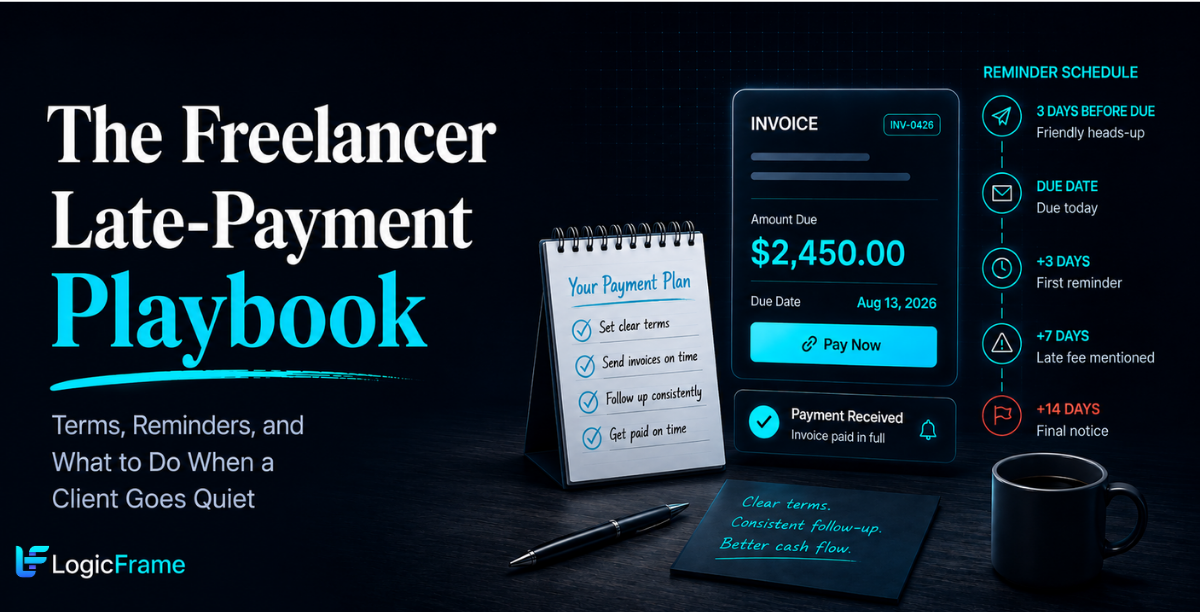
| Day | Action | Tone |
|---|---|---|
| 3 days before due | Friendly heads-up | Light, no pressure |
| Due date | "Due today" note | Still friendly |
| +3 days | First real reminder | Polite, direct |
| +7 days | Firmer reminder, late fee mentioned if applicable | Clear, professional |
| +14 days | Final notice | Formal, states next steps |
Most late invoices aren't actually disputes. The client forgot, the person who approves payment was traveling, or the email got buried. A polite, well-timed reminder resolves the majority of these on the first or second try. Escalating tone gradually, instead of jumping straight to firm language, keeps the relationship intact while still making it clear you're serious.
Copy-ready reminders
3 days before due (friendly):
Hi [Name], just a quick heads-up that invoice #[number] for [project] is due on [date]. No action needed yet, just flagging it so it's on your radar. Thanks!
On the due date:
Hi [Name], invoice #[number] is due today. Here's the payment link again for convenience: [link]. Let me know if you have any questions.
+3 days overdue:
Hi [Name], following up on invoice #[number], which was due on [date]. Could you let me know the status on your end? Happy to resend anything you need.
+7 days overdue:
Hi [Name], invoice #[number] is now a week past due. As noted in our agreement, a late fee of [amount/percentage] applies to payments made after [X] days. I'd like to get this resolved before that kicks in — let me know if there's an issue on your end.
+14 days overdue (final notice):
Hi [Name], invoice #[number] is now two weeks past due, and the late fee has been applied, bringing the total to [amount]. Please let me know today how you'd like to proceed. If I don't hear back by [date], I'll need to pause further work until this is resolved.
Step 5: Know when to stop
Reminders stop the moment payment is confirmed, not the moment the client says they'll pay. "Sent" and "received" are two different things, and it's worth waiting for the second one before you close the loop. Once you've confirmed payment actually landed, record it against the right project so your income picture stays accurate, instead of scattered across bank statements you'll have to reconstruct later.
What to do right now if a client isn't responding
If you're past the 14-day mark and hearing nothing at all, here's the order to work through:
- Send one more direct message, outside your usual invoicing channel. A short, personal email or message, not an automated reminder, sometimes gets a reply when nothing else has.
- Confirm you're reaching the right person. A surprising number of "late payments" are just invoices sent to someone who can't actually approve them. Double check you have the accounts-payable or actual decision-maker's contact.
- Pause further work, and say so clearly. You're not obligated to keep working while an existing invoice sits unpaid. Stating this plainly, calmly, often prompts action faster than another reminder.
- Know your legal options exist, even if you don't need them yet. Depending on where you and your client are based, there may be statutory protections — some regions give freelancers the automatic right to charge interest on very overdue invoices, and small claims court is a genuinely low-cost option for unpaid amounts under a few thousand dollars, usually resolving within a month or two, no lawyer required.
- Keep everything. Your signed agreement, the invoice, and your email trail are what you'd need if it ever went further. Most of the time, it won't get that far. But having the paper trail costs you nothing and removes one more thing to worry about.
Preventing the same thing next time
Once this invoice is resolved, the fix isn't to work harder at chasing the next one. It's to remove as many manual steps as possible: send the invoice automatically the moment work is approved, run the reminder sequence on a schedule instead of relying on memory, and stop it automatically the second payment clears. The freelancers who deal with this the least aren't the ones who are better at sending emails. They're the ones who built a system that doesn't depend on remembering to.
If you'd rather this whole sequence ran on its own, that's what Invoice Maker and Payment Chase are built to do — and once payment lands, Finance Friend records it automatically so you're never left reconstructing your income from memory.