
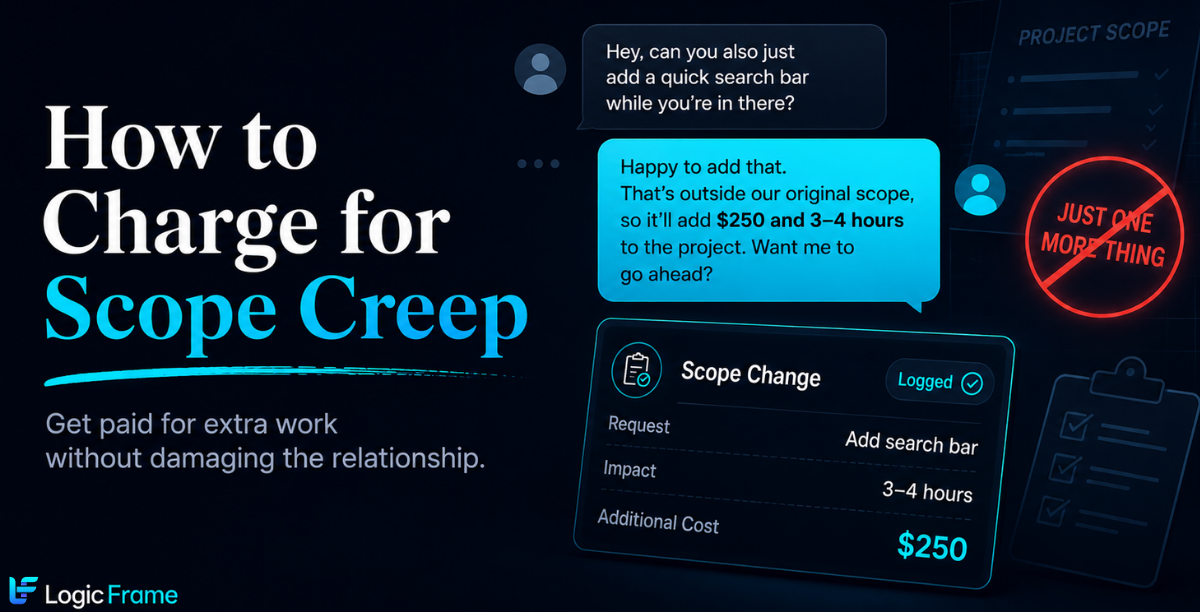
How to Charge for Scope Creep Without Losing the Client
Saying yes to 'just one more thing' for free feels safer than asking for more money. Here's why it isn't, and exactly how to charge without damaging the relationship.
The client sends a message. "Hey, can you also just add a quick search bar while you're in there? Shouldn't take long."
It's not in the original agreement. You both know it, even if neither of you says it out loud. And in that moment, you do a quick calculation: is it easier to just do it for free, or to bring up money and risk sounding difficult?
Most freelancers pick free. Not because they don't know they could charge. Because charging feels like a bigger risk than it actually is.
Why freelancers don't charge for extra work, even when they know they should
This isn't really a pricing problem. It's a fear problem.
A lot of freelancers quietly believe that if they do enough extra work, the client will keep coming back, or think of them as easy to work with, or just like them more. Some of it comes from being taught to never say no. Some of it is just wanting to avoid an awkward conversation over what feels like a small ask.
The catch is, none of these small "just one more things" stay small. One turns into two, two turns into five, and by the end of the project you've done real, unpaid work with nothing to show for it, and you're the only one who knows it happened.
The extra work is not actually free, even if it feels small
Here's a way to think about it that makes the money conversation feel less confrontational. A restaurant doesn't hand you a free side dish because you asked nicely. A furniture store doesn't throw in extra pillows because you're a good customer. Everyone accepts that adding something to an order adds to the cost. Somehow, when it's freelance work, that same logic gets forgotten, by both the client and the freelancer.
Charging for extra work isn't you being difficult. It's you running your business the same way every other business already runs theirs.
How to actually bring it up without sounding difficult
The trick isn't finding the perfect wording. It's changing when you say it. Most freelancers wait until they're annoyed, and by then the request already feels personal. Bring it up the moment it happens instead, while it's still just a normal, practical conversation.
Something like this works for almost any situation:
"Happy to add that. Just so you know, that's outside what we originally scoped, so it'll add [time/cost] to the project. Want me to go ahead?"
That's it. No apology, no long explanation, no guilt. You're not asking permission to charge money, you're just stating a fact and letting them decide. Most clients say yes without any pushback, because you handled it like it was normal, so it feels normal to them too.
Log it the moment it happens, not later
The reason this conversation feels hard in the moment is that you're making a judgment call on the spot, with no record to back you up. If you've been tracking every small addition since the start of the project, the conversation stops being a guess and becomes a simple fact: "this is the fifth thing outside the original scope, here's what it adds up to."
Waiting until the end of a project to bring any of this up is where it goes wrong. By then it feels like a surprise bill, and surprise bills are what actually damage a client relationship, not the extra charges themselves. Logging changes as they happen means you're never blindsided, and neither is the client.
Boundaries build trust, they don't break it
It feels backwards, but clients generally respect freelancers who charge for scope changes more than freelancers who don't. A clear boundary signals that you run this like a real business, and that you'll do the same for them, protecting the project instead of just saying yes to keep the peace.
The freelancers who lose clients aren't usually the ones who charge for extra work. They're the ones who say yes to too much for free, get quietly resentful, and eventually either burn out on the project or let their frustration show. Charging fairly, calmly, every time, is what actually keeps the relationship healthy long term.
If tracking every scope change as it happens sounds like something you'd rather not do manually, that's exactly what Scope Creep is built for.